Default Windows power plans are too broad, often forcing a trade-off between performance and battery life. This is why I decided to move beyond the basics to build a setup that actually adapts to my needs. Here is how I created the perfect power plans for every situation with the help of a free tool.
Creating Custom Power Plans Using ThrottleStop
The main downside of the Windows power plans is the limited control over CPU behavior. The CPU is not only one of the highest power-drawing components, but it also acts as a bottleneck for the whole system, like how it bottlenecks the GPU. Gaining granular control over CPU power is one of the best ways to manage PC power, and this is where the ThrottleStop app comes in.
While ThrottleStop is often used for disabling PC throttling and managing CPU voltage, it’s a great tool for managing power profiles as well. I have used it to create four custom power plans that I can quickly switch to depending on my needs. Here’s a quick overview of the settings we’ll adjust so you know how to manage them:
- Power profile: this is actually a shortcut to switch between the Windows default power profiles. Since ThrottleStop applies its adjustments on top of the Windows default profiles, it’s important to have the right one selected here.
- Speed Shift EPP: this option decides how fast your PC switches between high and low clock speeds. Here, 0 value is maximum performance, and 255 value is maximum efficiency.
- Disable Turbo: this function disables Intel’s Turbo Boost technology so the CPU only runs at its base clock speed. It greatly enhances battery timing and prevents the CPU from overheating at the cost of performance.
- C1E: the auto-sleep function of your CPU. It puts non-essential parts of the processor to sleep when it’s not doing anything (even for a fraction of a second) to save power.
Maximum Performance Profile for Gaming and Low-Latency Activities
When you want the absolute best performance with no regard for power saving, this is the profile you’ll use. We won’t just be unlocking the best PC performance; we’ll be eliminating all power-saving features that may cause micro latency.
This power plan isn’t made for regular use, even when running heavy apps. It should only be used when even slight latency isn’t acceptable. I personally use it when playing competitive games, but it can also be used when doing tasks like live streaming, video editing, audio production, etc. Below are the ThrottleStop settings you’ll adjust:
Power profile: Checked and High Performance selected
Speed Shift EPP: Checked and set to 0
Disable Turbo: Unchecked
C1E: Unchecked
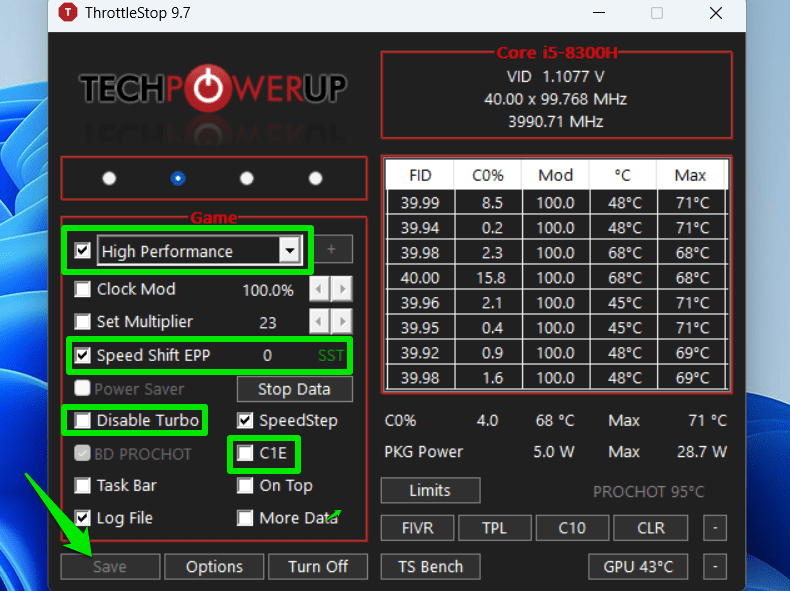
Keep all the other options set as default and click the Save button when you are done.
Performance Profile for Work and Everyday Tasks
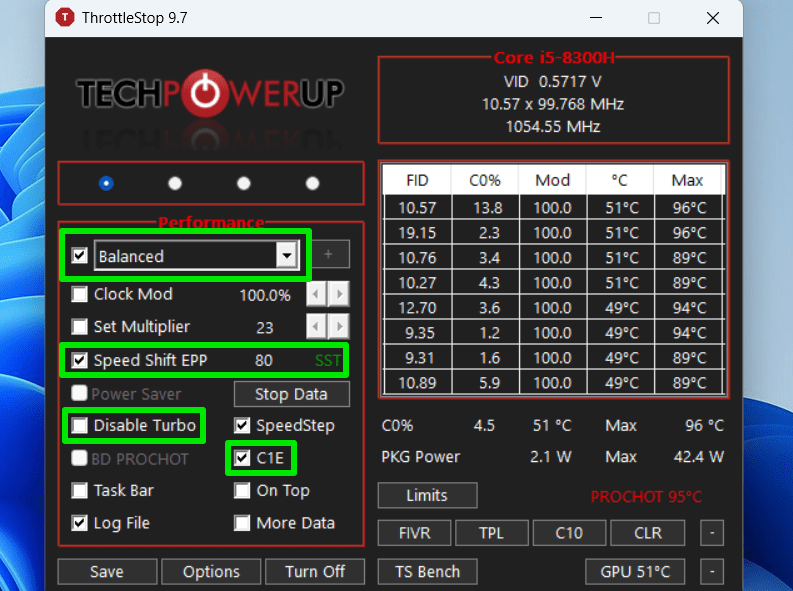
When you are on AC power and want to have access to the full CPU power while still saving power and minimizing heat, this is the plan you’ll use. This will let your PC reach its full potential when needed (like running a heavy app), but still stay at low power when idle or doing lighter jobs.
You’ll use this profile most of the time when on AC power (or using a desktop); this includes gaming, as minor stutters or frametime issues are acceptable in most games. In ThrottleStop, click on one of the white dots at the top to change profile and apply the following adjustments:
Power profile: Checked and Balanced selected
Speed Shift EPP: Checked and set to 80 (or 128 for even less power consumption)
Disable Turbo: Unchecked
C1E: Checked
Battery Power Profile for Longer Battery Life
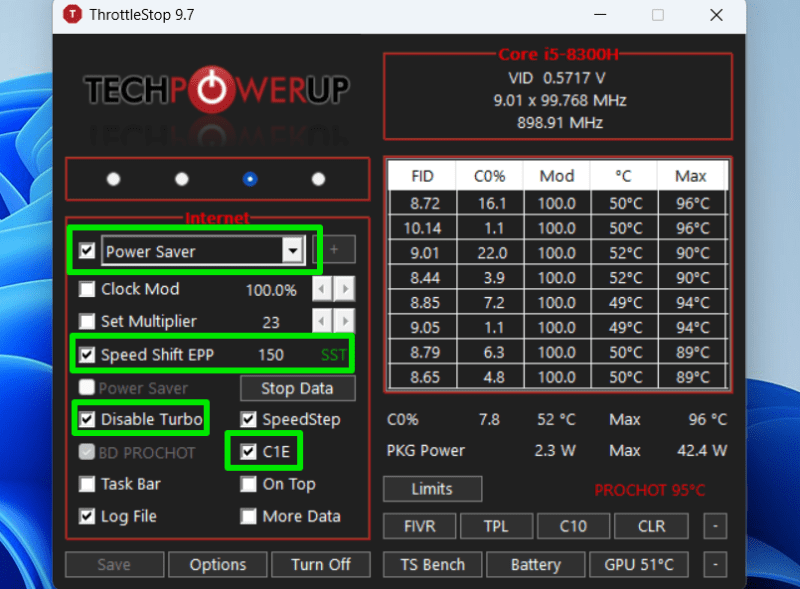
When you are on battery or just want to minimize power consumption, you can use a custom power plan that gives enough power to do basic tasks while saving battery. The profile settings below will allow you to browse the web, stream videos, and even play light games without significantly slowing the system.
Power profile: Checked and Power Saver selected (Balanced acceptable as well)
Speed Shift EPP: Checked and set to 150 (select 180 for more efficiency)
Disable Turbo: Checked
C1E: Checked
If you prefer to have good performance even on battery, you should check out my post on saving battery without losing performance.
Extremely Low Power Consumption Profile for Emergencies
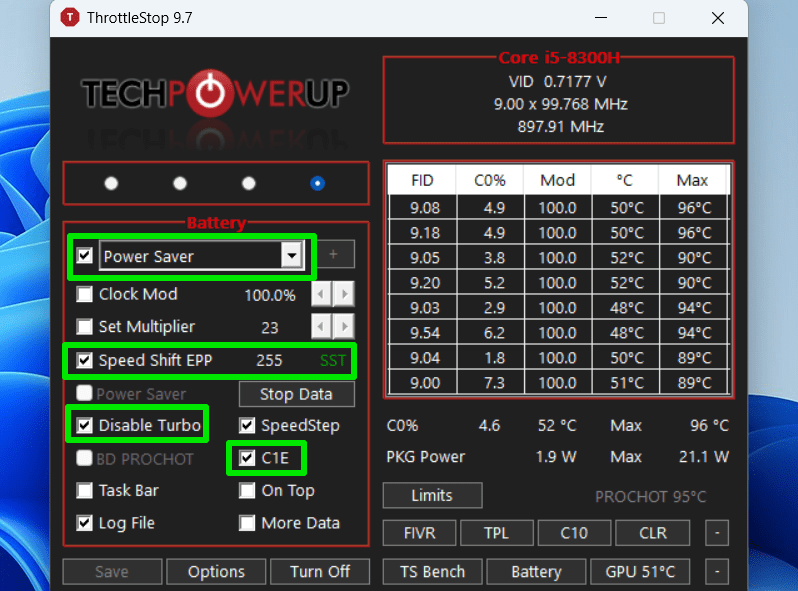
When your sole goal is to keep the device running as long as possible, then this power plan will heavily limit performance to ensure the lowest power consumption. You’ll be able to do basic stuff like working on a document or basic browsing, but there will be delays and stutters. Below are the adjustments you need to make:
Power profile: Checked and Power Saver selected
Speed Shift EPP: Checked and set to 255
Disable Turbo: Checked
C1E: Checked
You should also set the screen brightness to the lowest, as it consumes the most battery.
The profiles only kick in when ThrottleStop is running, so I’ll recommend scheduling it to start with Windows. Along with these profiles, you should also look into undervolting the CPU and GPU, as it helps the PC run at maximum clocks while consuming less power.