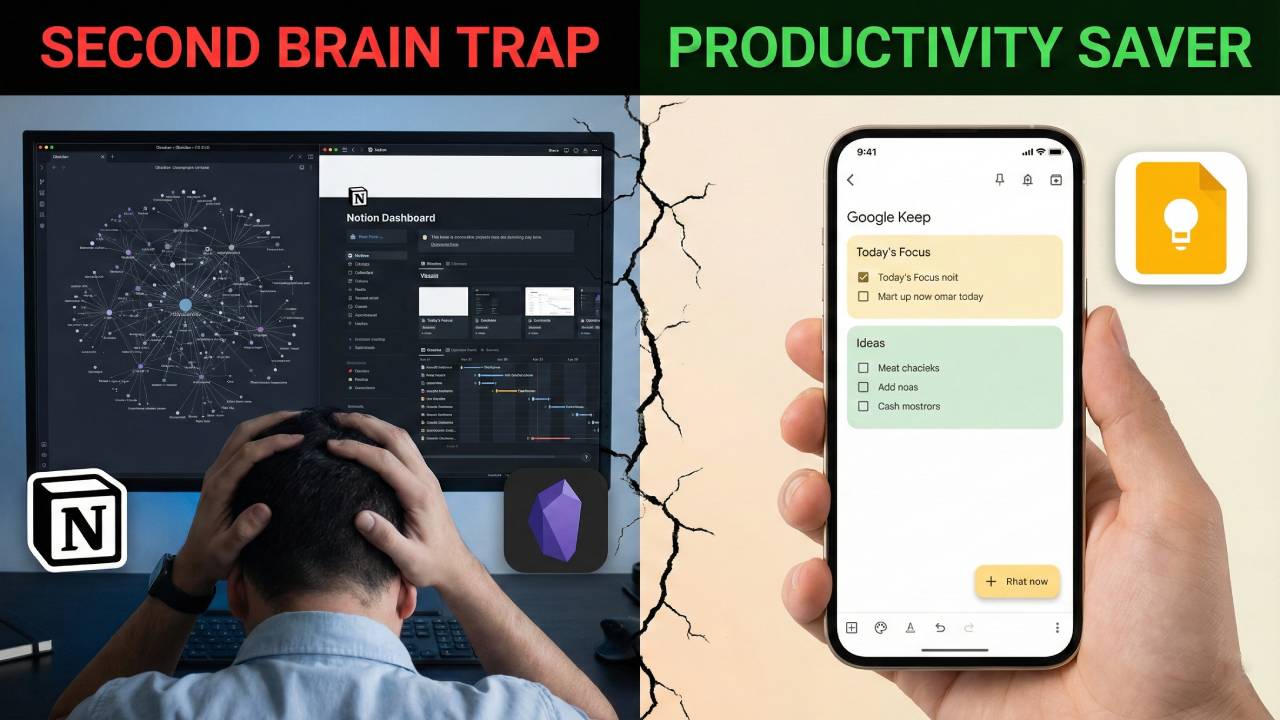
If you’ve been following the productivity landscape recently, you must’ve come across tons of posts recommending apps like Notion, Obsidian, and NotebookLM. Most posts pose these apps as some magic pill to boost your productivity, creating a feeling that you’re missing out on some shortcut to success. Well, I hate to break it to you — they’re not, and it’s likely a productivity trap for you.
The ‘Geeky Procrastination’ Diagnosis
As a chronically lazy person, I try to read up a lot on tips and tricks to improve my productivity. So, naturally, when the productivity coaches recommend stuff, I get the urge to try them out. I had been hearing about these Second Brain, Knowledge Base tools for a while now, and it was giving me a severe case of FOMO.

Recently, I finally got the time to look into these apps, and I swear, I tried so hard to integrate them into my workflow but failed to see how they’d actually help my work. Here’s the thing — these are amazing pieces of software that do what they promise, but there are specific use cases for each of them. If your work doesn’t fall under those use cases, these apps become a form of sophisticated procrastination.
The thing is, it gives you a geeky feeling when you’re configuring those dashboards, delivering mini dopamine hits along the way. However, at the end of it all, you might realize you haven’t really done any actual work and potentially created a ‘Second Brain’ that you’ll never really use.
Before I tell you exactly why these tools are not suitable for me (and probably you), I ought to tell you scenarios where they’d actually be useful because, to be fair, the apps themselves are not misleading in what they claim to do.
Notion
First, I looked into Notion, trying to understand how it works and what it can do for me. What I found out was that it’s more of an AI-powered project management app. It’s great for managing projects involving a team of contributors that you want to keep on the same page with project tracking, note-taking, and knowledge base features.

It’s also a pretty useful tool for students to pile up their notes in one place, creating a knowledge base over time that they can sift through manually or using the built-in AI features. In this age of digital education, a tool like Notion does make a lot of sense, since you don’t always get physical books and notes anymore. For these use cases, Notion has a bunch of productivity-boosting tricks up its sleeve.
Obsidian
Obsidian does most things that Notion does, but it focuses less on the project management side and doubles down on creating a versatile knowledge base. You can create graphs and canvases and link your notes to each other to transform your journaling mess into accessible data. It’s indeed one of the best note-taking apps out there.
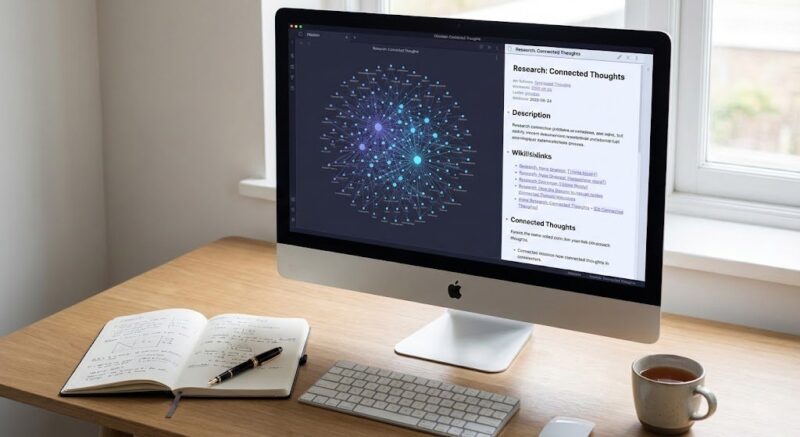
In my opinion, the target audience of Obsidian is students, story writers, and any deep thinker in general. It can handle complex notes and make them manageable by weaving them into a visually less intimidating Second Brain of sorts.
NotebookLM
Compared to the other two, NotebookLM is a new kid on the block by Google. In all honesty, it doesn’t have a whole lot of feature overlap with Notion and Obsidian — it’s in a niche of its own.

NotebookLM is an awesome tool for learning new stuff and consuming knowledge in unique ways. The LM in the name stands for Language Model, which essentially means that instead of using LLMs like Gemini or ChatGPT to look up information from all over the web, you get to feed it with specific material, so it only answers using those references.
Another killer NotebookLM feature, which is a state-of-the-art way to learn, is podcast creation. So, instead of asking questions about the material you feed it, you ask the tool to create a podcast of two people discussing the topics in your source data, which you can listen to anytime. This way, you learn new things without needing to ever read a word. Pretty cool!
Why Using a Simple Note-taking App Works for Me
Okay, so while these apps are useful in their unique ways, they don’t really add any benefits to any of my workflows. You see, the companies I work for provide me with a wiki of all their guidelines that I can read and refer to anytime. It’s usually written by my peers in a language that is pretty easy to understand because they know exactly what a newbie in our field would need to get started.

These companies also use project management tools like Trello, Asana, or ClickUp. So, the knowledge base and project management are not an issue for a freelancer like me, essentially eliminating the need for Notion and Obsidian. But there are times when I do need to take personal notes and create a private task management solution.
Well, that’s where simple tools like Google Keep and Google Tasks come in. I mean, these are more linear solutions than to create a duplicate of the knowledge base and project management, which the companies I work for have already got covered through premium apps.
The only tool that’d actually help me would be NotebookLM in case I’m working on a project where I have to learn new stuff or go through bulky technical documentation. In such cases, I’d definitely use it, but that’s about it. I mean, why resort to using a Second Brain when my First Brain would clearly suffice…
Increasing Productivity Doesn’t Always Need Complex Setups
I know I have generalized the true purpose of these tools to an extent. However, the point of sharing this whole experience with you isn’t to berate these tools — as you’ve seen, they’re pretty handy solutions to specific problems, just not my problems and maybe not yours either. Adding additional steps to your workflow just to follow some trend isn’t the solution to fixing your productivity. A lot of times, as in life as a whole, simplicity outperforms complexity.
I let the productivity maestros take over my mind, making me try to fix something that wasn’t really broken. I ended up wasting a lot of time looking up and trying to understand these tools, which I didn’t really need at the end. The thing is, people ought to clearly mention the use cases of these apps so that their audiences know when they’d actually be helpful. The companies behind these tools don’t really advertise them as magic productivity pills — it’s the content creators who try to sell them as snake oil, claiming miracles and creating FOMO among their audiences.