
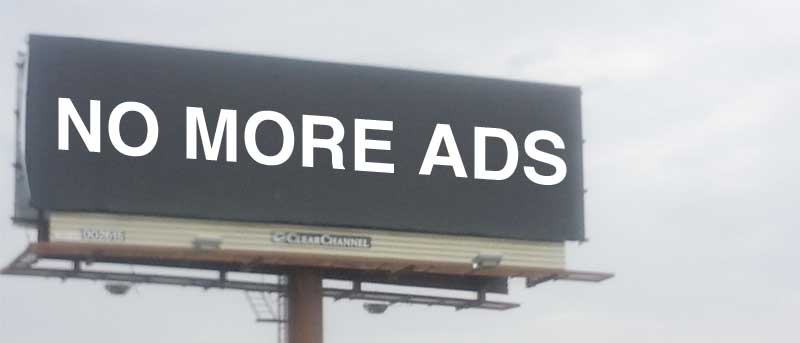
Will You Pay to Remove Ads from Sites or Apps? [Poll]

Call it a necessary evil. You’re cruising around the Internet and find a great website you love, but then get some annoying pop-up ads that distract you from what you were doing. Or perhaps you’re playing a new game on an app, but you can’t seem to get anywhere without being hit with annoying ads. Of course for a fee you can get rid of those ads. Is it worth it?

You have to admit it’s good business. The websites that charge for a membership to avoid ads and the apps that offer an ad-free experience for a fee know that you want their product. You were already browsing the website, so you are obviously interested in what it has to offer. The apps are in the same situation. You already downloaded the free version. You’re interested. However, no matter what your interest level is, the annoyance factor is still there. No one wants to be interrupted by pop-up ads.

The websites and apps need them, though, to help pay their costs. But even understanding why websites and apps throw in the pop-up ads doesn’t make it any easier to put up with them. You can click them and get them to go away, only to have more pop up in their place later on.

What do you do? Will you pay to remove the Ads from Sites and Apps?

Subscribe to our newsletter!

Our latest tutorials delivered straight to your inbox

Laura Tucker Avatar

Read next

Wi-Fi doesn’t actually slow down when a café gets crowded — the signal is fine, but every device has to wait its turn to speak on the same frequency, and the polite queuing is what you feel as lag
In 1988, a 23-year-old Cornell graduate student named Robert Morris released a self-replicating program to measure the size of the internet — within hours it had crashed roughly 6,000 of the 60,000 machines then online, and computer security became a field
In July 2026, Psy’s Gangnam Style passed six billion YouTube views, fourteen years after its horse-riding dance became the platform’s first billion-view video and long after engineers had replaced a counter designed to stop at 2,147,483,647
Suzanne Simard sealed paper birch and Douglas fir seedlings inside plastic bags, fed them carbon-14 and carbon-13 dioxide, and nine days later found carbon had crossed between species through fungal threads in the British Columbia soil beneath her boots
A species of jellyfish called Turritopsis dohrnii can revert its adult cells back to a juvenile polyp stage when injured or starving, effectively restarting its life cycle, and biologists have so far failed to identify any natural limit to how many times it can do this.
A Japanese man named Jiroemon Kimura, who lived to 116, was born in 1897 when Queen Victoria still ruled and died in 2013, meaning a single human life personally overlapped with the invention of the airplane, the atomic bomb, the internet, and Instagram
The Hollywood sign originally read HOLLYWOODLAND when it was built in 1923 as a real estate advertisement for a housing development, and it was only meant to stand for 18 months, but nobody ever got around to taking it down and the city eventually adopted it as a landmark
Almost all of the world’s internet traffic does not travel by satellite but through fibre-optic cables lying on the ocean floor, a hidden web of wires crossing the deepest parts of the sea to connect the continents.