
Sleep-Tracking Apps and Devices May Not Indicate Quality of Sleep

News Sleep Tracking App Featured

It’s an invention we didn’t even know we needed before we had smartphones and wearables. But now that we can so easily monitor our sleep with our phones and devices, somehow it seems like a necessity.

It can be easy, though, to get caught up in what the sleep-tracking app or device is showing, all the times you weren’t getting good sleep. And now in addition to not getting good sleep, you’re worried about it, which makes it even harder to sleep. But it turns out you don’t need to worry, as the sleep-tracking apps and devices may not indicate the quality of your sleep.

Dependency on Sleep Tracking

There are many sleep-tracking apps that are available, and wearables like the Apple Watch and Fitbit can track your sleep as well, But many of them work the same. You put your phone or device near you when you’re sleeping, and it starts measuring the minute you crawl into bed, whether you’re sleeping or not, and finishes when you shut it off.

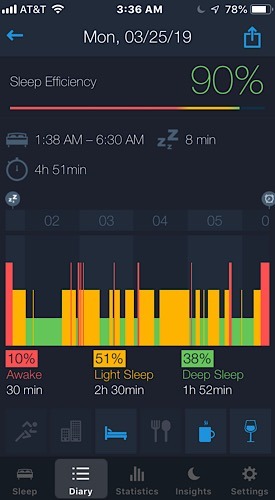
It will show when you’re awake, when you’re in a deep sleep, and when you’re in a light sleep. But there are many times it says you were awake, And you don’t remember being awake through all that. And you had no idea so much of your sleep was light sleep and not deep sleep.

Researchers asked people in a 2014 study what they thought of their sleep quality, then showed the data from a sleep test. They lied to them, though. Some were told they had more REM sleep than the average person, and others were told they had less.
News Sleep Tracking App Data

Their cognitive ability in testing usually matched what they were told of their sleep quality. They believed the fake test results more than how they actually felt about how they slept.

A 2017 paper, though, written by sleep specialists, supported the idea that sleep-tracking apps are interfering with their patients’ treatments.

“All three patients were spending excessive time in bed in attempts to increase the sleep duration reported by the sleep tracker,” said the sleep specialists, “which may have exacerbated their insomnia. Given that these devices tend to overestimate sleep, they may have served to reinforce poor sleep habits by encouraging extending time in bed.”

Getting a Good Night’s Sleep

What there isn’t any data for, though, is how often the apps are right and how often they’re wrong. Maybe they’re on target more often than we think, but maybe they’re off more often than we think. But what the scientists are saying is that it’s more important how you feel.

Do you use a sleep-tracking app or device? Does it influence how you feel about your sleep, good or bad? Tell us how you feel about your sleep compared to what the sleep tracker says in the comments below.

Subscribe to our newsletter!

Our latest tutorials delivered straight to your inbox

Laura Tucker Avatar

Read next

The Big Ear telescope was scanning at 1420.4056 megahertz on the night of 15 August 1977, the exact frequency at which hydrogen atoms vibrate across the universe, because Giuseppe Cocconi and Philip Morrison had argued years earlier that any species trying to be found would broadcast on that channel — and then, for 72 seconds, something did.
In 2016, archaeologists dated two rings of snapped stalagmites in France’s Bruniquel Cave to 176,500 years ago, evidence that Neanderthals had walked 336 metres into darkness with fire and built architecture deep underground long before modern humans reached Europe
Otto von Bismarck was 74 when Germany adopted the world’s first national old-age social insurance program in 1889, setting the pension age at 70 after years of fighting socialists with bans, laws, and a promise few workers would live long enough to use
When cosmonaut Valeri Polyakov stepped out of his Soyuz capsule in March 1995 after 437 consecutive days aboard Mir, doctors recorded him at several centimetres above his pre-flight height, and his spine had become so unaccustomed to gravity that the recovery team carried him to a chair rather than risk the compression of letting him walk.
When Bell Labs engineer Karl Jansky pointed a rotating antenna at the sky in 1932 looking for sources of transatlantic radio static, he kept picking up a faint hiss that peaked every 23 hours and 56 minutes, and he eventually realized he had become the first human to hear the center of the Milky Way.
When Harvard astronomer Cecilia Payne submitted her 1925 doctoral thesis arguing that the Sun was made almost entirely of hydrogen, the field’s senior figure Henry Norris Russell talked her into adding a line calling the result ‘almost certainly not real,’ and then published the same conclusion himself four years later to widespread acclaim.
When seismic waves from the Chicxulub impact reached what is now North Dakota roughly ten minutes after the asteroid struck, they appear to have triggered a ten-metre standing wave in an inland river that flung fish onto the bank and buried them under glass beads still falling from the sky.
When survivors near Lake Nyos woke on the morning of 22 August 1986, the cattle were dead in the fields, the birds had fallen out of the trees, and 1,746 of their neighbours were lying where they had stood the night before, with no fire, no flood, and no wound to explain it.