

The rise of social media, especially as a news source via Facebook or Twitter, has resulted in the viral spread of information. This manifests in a number of ways: humorous memes, for instance, often spread like wildfire on social media platforms. Chances are if you’ve used any social media platform, you’ve been hit by some of these. However, information doesn’t need to be true or funny to go viral it can be a half-truth or even an outright lie.
That brings us to the question of the day.
Is Social Media Changing the “Truth”?
The short answer is yes.
The long answer is that human beings are prone to what’s known as “confirmation bias.” Confirmation bias occurs when people interpret and spread information that aligns with their beliefs. It doesn’t help that Facebook encourages this with its algorithms.
As an innocent example, let’s say you believe “Fantastic Beasts” was a grossly-overrated movie. Due to your confirmation bias in this case, you would be likely to share reviews and opinion pieces that align with your beliefs.
As a not-so-innocent example, let’s say you believe a politician to be morally corrupt, bordering on outright evil. In this case, your confirmation bias may lead you to believe any negative thing said about the opposition, which on social media means you’re more likely to share unsubstantiated rumors and treat them as fact.
This confirmation bias, when combined with the rapid-fire sharing nature of platforms like Twitter, Facebook and Tumblr, means that falsehoods can spread like a virus in the span of mere minutes. Major world events can be skewed and misrepresented to people at large in the span of just an hour. Social media progresses at such a speed that people don’t tend to perform their own research on whatever tasty morsels of information they happen to find; if it suits their bias, they’re likely to share it.
The Bandwagon Effect
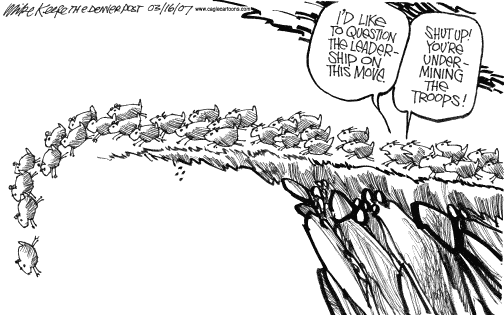
When this happens on a large enough scale, something called the “bandwagon effect” comes into play. This is another psychological term, and it is used to describe when people’s ideals, beliefs and actions are shaped by what they see in the masses. If all of your friends and family are sharing this story, it must be true, right?
The combination of these factors (the speed at which social media spreads information, the psychology of confirmation bias and the strength of the bandwagon effect) means that fake news has just as much a platform, if not more so, than real reporting. This, combined with growing distrust for major media outlets and a growing paranoia around topics like government surveillance, means that social media has changed the “truth”.
Or, at least, what people perceive as the truth.
Tools and the Best Practices for Staying Informed
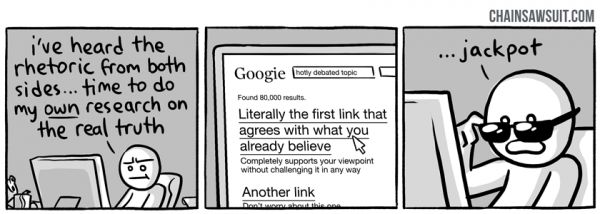
First of all, remember the importance of research. A Google search is always a few keystrokes away. Don’t just click the first link and listen to what it says alone; check multiple links, follow sources to their root. Don’t let yourself be caught in supposedly-genuine news stories that actually originate from random Twitter posts. Even major news outlets fall for those on occasion.
If something sounds too good to be true, it probably is. If something is so terrible you don’t want it to be true, chances are it might not be. In either case, research the information you’re presented with, whether it agrees with your pre-existing biases or not.
Two great tools you can use for fact-checking are Politifact and Snopes. Both of these sites operate as politically neutral as possible, while also providing a multitude of sources and a list of all leads used to come to their conclusions. If you find their research suspicious, you’re more than welcome to dive into their sources and do some research of your own.
Just be wary of random “news” sites, and don’t trust everything you read on the Internet at first glance. Given the right practices, you’ll never be fooled by fake news – you just need to make sure that you’re doing the research necessary to avoid it. Social media may be skewing your perspective, but that doesn’t mean you need to be fooled.