

It has happened to every one of us who uses social media. You’re cruising around catching up on what’s happening with your friends, and you see an ad for something you just mentioned hours earlier. It can be downright creepy at times.
Instagram head Adam Mosseri was pressed in an interview with Gayle King of “CBS This Morning,” and this was something she demanded an answer to. She wanted to know how she could have a private conversation about an item, only for it to then appear as an ad on Instagram. She asked if she was being recorded.
Mosseri Defends Instagram Ads
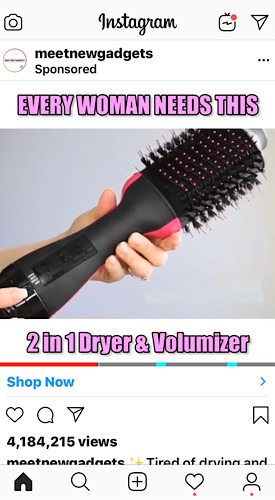
This happened to me. I was out with friends and talking about my hair, and I decided I needed to get a hot air brush to maintain the style. That next day when I was on Instagram, I was hit with the ad pictured below. Sure, it’s what I was looking for. I bit the bullet and bought it.
“Can you help me understand how I can be having a private conversation with someone about something I’m interested in seeing or buying, and an advertisement for that will pop up on my Instagram feed?” King asked Mosseri.
“I haven’t searched for it, I haven’t talked to anybody about it. I swear, I think you guys are listening — I know you’re going to say you’re not.”
Not surprisingly, Mosseri said he gets asked that very question “all the time.” His answer was less than satisfying. It certainly did nothing to quell that uneasiness felt when something pops up that makes you feel they’re listening to you.
One of his explanations was that the ad appearance is just “dumb luck.” He also suggested users may have interacted with related content on Instagram and that was in their subconscious, leading them to then talk about it with someone else.
“So maybe you’re really into food and restaurants, you saw a restaurant on Facebook or Instagram, you maybe liked the thing — it’s top-of-mind, maybe that’s subconscious, and then it bubbles up later,” he explained.
“We don’t look at your messages; we don’t listen on your microphone,” Mosseri promised. “Doing so would be super-problematic for a lot of different reasons.”
“I’m not the first one that said that. I don’t believe you; I don’t know how this happens repeatedly,” King said, echoing the thoughts of everyone else.
Sure, I had looked up the hot air brush a few weeks earlier to see it on Instagram. But I never did so directly on Instagram. I looked on Amazon, and I researched on Google. So how does that get to Instagram the day after I decided I needed to quit researching and just buy one?
Facebook has been facing privacy concerns for a long time. Mark Zuckerberg’s social network acquired Instagram in 2012. His social network has long been accused of recording users as a way to tailor ads. He argues against it and says it’s just a “conspiracy theory.”
However, possibly even more creepy, former Facebook product manager Antonio García Martínez said in 2017 that they don’t need to record conversations, as “[Facebook] is tracking you in other — no less insidious — ways you’re not aware of.”
If I were discussing this on Facebook or Instagram, I’d be inserting the wide-eye emoji here.
Only Two Choices
At this point we have three choices. We can choose to believe Instagram/Facebook that they’re not recording us and go on about our business, we can reject the social networks and refuse to use them again, or we can accept there’s something more going on than being recorded and decide to trust them because we really like using Instagram and Facebook.
What are you going to choose to do? Will you continue to use Instagram and Facebook despite the creepy ads? Or have you had enough and are deleting the apps as soon as you get done reading this? Add your thoughts to the comments below.