


It’s no secret that Apple banks on its popular services as being part of its ecosystem. It makes money from you buying devices but also on apps and services that run on your devices. Interestingly, out of more exciting services, like Podcasts, Music, and TV+, the iCloud storage service sees the most users.
Report Shows iCloud Storage the Most Popular Apple Service
With rumors that the new Apple Intelligence will initially be free, but sometime later become a paid Apple service, CIRP took a look at the current most popular Apple services. As it has been in the past, iCloud storage has the most users. The question is, is it the most popular because people care about their storage the most, or does it have more signups because of the low cost?
But among AppleCare, iCloud, and the entertainment-related services of Music, TV, Podcasts, and News, iCloud is the clear winner with 64 percent of customers opting for additional storage.
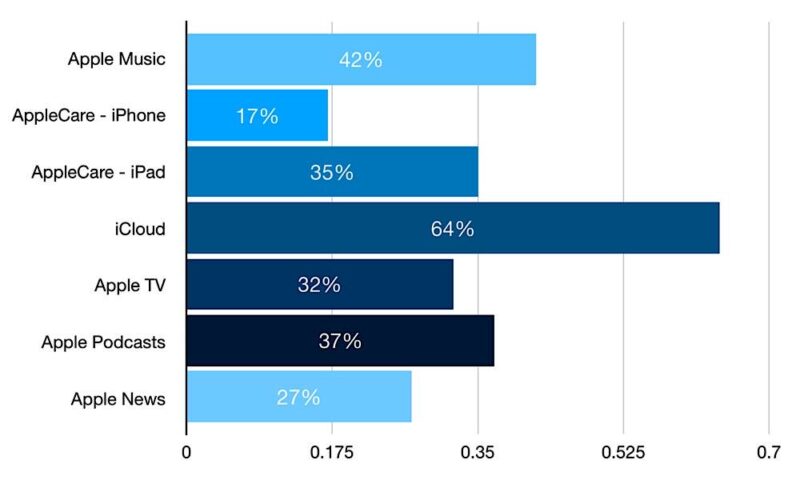
Notably, out of the services that CIRP examined, it didn’t show data for Fitness and Arcade, but I don’t think any of us would expect those two services to be the most used. Additionally, CIRP noted that their collected data didn’t include activity in the App Store.
Also of note, it’s not mentioned whether customers of the Apple One plan are included. For one monthly price, you get access to iCloud storage, TV+, News, Music, Arcade, and Fitness. But it does include data on Podcasts and News, even though these are not necessarily free services. They can be but don’t have to be, and people responding to this survey may have thought it was only for paid services. It’s left unclear.
Tip: learn how to share your Apple Music library with your family.
Surprisingly, people don’t seem to care as much about protecting the costly devices that they are buying. You would think there would be many AppleCare warranty service customers, but there are not.
Why Are There More iCloud Buyers?
Apple device buyers are encouraged to purchase an AppleCare warranty, but clearly not all do, but the data shows they are more likely to buy it for an iPad than they are for an iPhone.
Similarly, when you run out of room to store your photos, apps, and other data on your device, Apple encourages you to opt for a paid iCloud storage service. The cheapest of which is 99 cents/monthly. That makes it an easy decision.
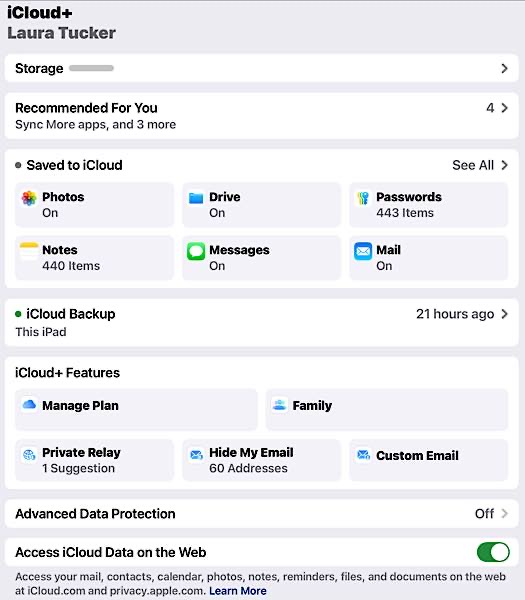
Added to that, you never have less data to store. Computer and device storage just gets larger and larger. It means you’re less likely to decide you no longer need the storage plan.
I have the Apple One plan for family and get everything included. I purchased this after myself and two family members were each already paying for the 99 cents/monthly option. But Apple never took that off my bill. So I’m still charged for those small iCloud plans as well as Apple One. I guess, then, that I’m still an iCloud buyer, but I just don’t get around to contacting Apple to get 99 cents taken off my bill.
Getting the iCloud Storage Full message on your Mac? We can help you shut if off. If you’d rather do without Apple iCloud storage, check out cheap cloud storage for students.
Image credit: Unsplash. Bar graph and screencap by Laura Tucker.