

People use GPS extensively every day, but not many people know how it actually works. How can a smartphone know where you are, to the point you can use it as accurate directions while you drive?
Let’s open the hood on GPS and see how it works.
Also read: It’s Not Just GPS: We Have Six Global Navigation Satellite Systems, and They’re Getting Better
How GPS Finds You
Let’s say you’re hiking in the woods when you get lost. That’s alright, though: you had the smarts to download the official app for these woods. The app claims to help you find your way, no matter where you are.
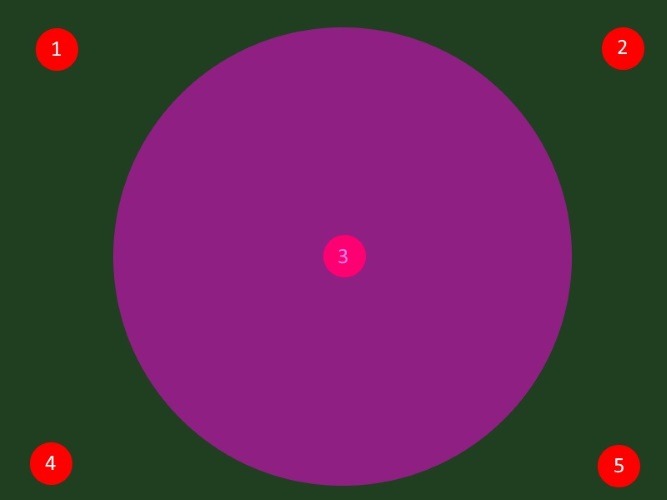
The way the app does this is via five beacons set up around the forest: one in each corner and one right in the middle. You use the app to ping one of the beacons, and it tells you how far away from it you are. Easy!

You ping tower 3, the middle one. The result comes in – you’re around 5.5 miles from the beacon. You think you’re home free, but there’s a problem: it doesn’t state which direction you are from the beacon. You could be north, south, east, or west of the beacon – there’s no knowing. As such, you can say you’re somewhere in a 5.5-mile radius around the beacon. Not very useful!
You decide to ping tower 2 in the hopes that it’ll prove more fruitful. Not at all, as it just says you’re 3.2 miles away. No direction either. Great. This, too, is just a useless circle.

But hold on a moment; what if we combined the data we got from beacon 3 with the one from beacon 2? If we’re 5.5 miles away from beacon 3, and 3.2 miles away from 2, then it puts us around here:
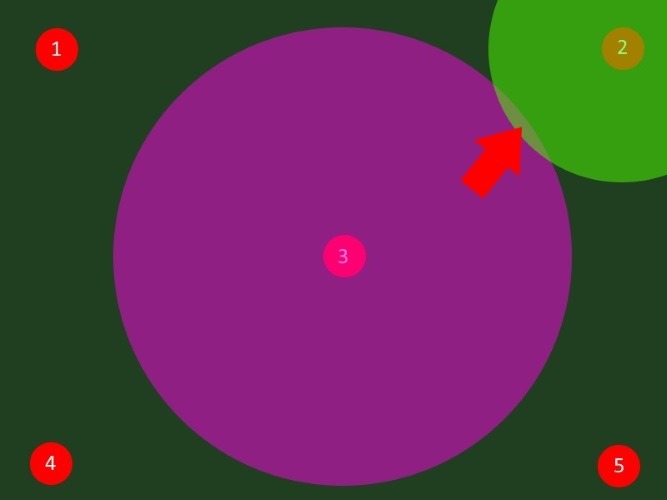
That’s much more useful! While the information from a single beacon isn’t very useful, we get more and more of an idea of where we are when we ping multiple beacons. We can then collect the data from each beacon and find where we are.
Also read: Android GPS Not Working? 9 Fixes to Try
How GPS Triangulation Works
As you may have guessed, the above example is how GPS finds you. When you enable GPS, your phone begins communicating with the GPS satellites orbiting Earth. The satellites can’t tell you where exactly you are, but it can look at how long it takes to receive the request and calculates your position based on this.
Like the above example, a single satellite will give you a rough idea of where you are. Have you ever activated GPS on a map, and all you see is a huge circle around where you currently are? That’s because your phone is talking to only one satellite, which is making a rough guess of where you are.
Things get more refined when more satellites give their responses. Your phone then takes all the information coming in from these satellites and finds where the rings meet. This is called “triangulation” and is how GPS works!
Finding Your Way with GPS
We use GPS often when finding our way, but it’s not immediately obvious how it works. Now you know how satellites locate where you are and why it sometimes puts a very useless “you are here” circle over an entire city!
Has GPS been an accurate pathfinder for you? Let us know below.