
Get an Emerson Sensi Smart Thermostat for Under $100

We may earn a commission from links on this page.
Deal pricing and availability subject to change after time of publication.
Deal Emerson Sensi Thermostat Featured

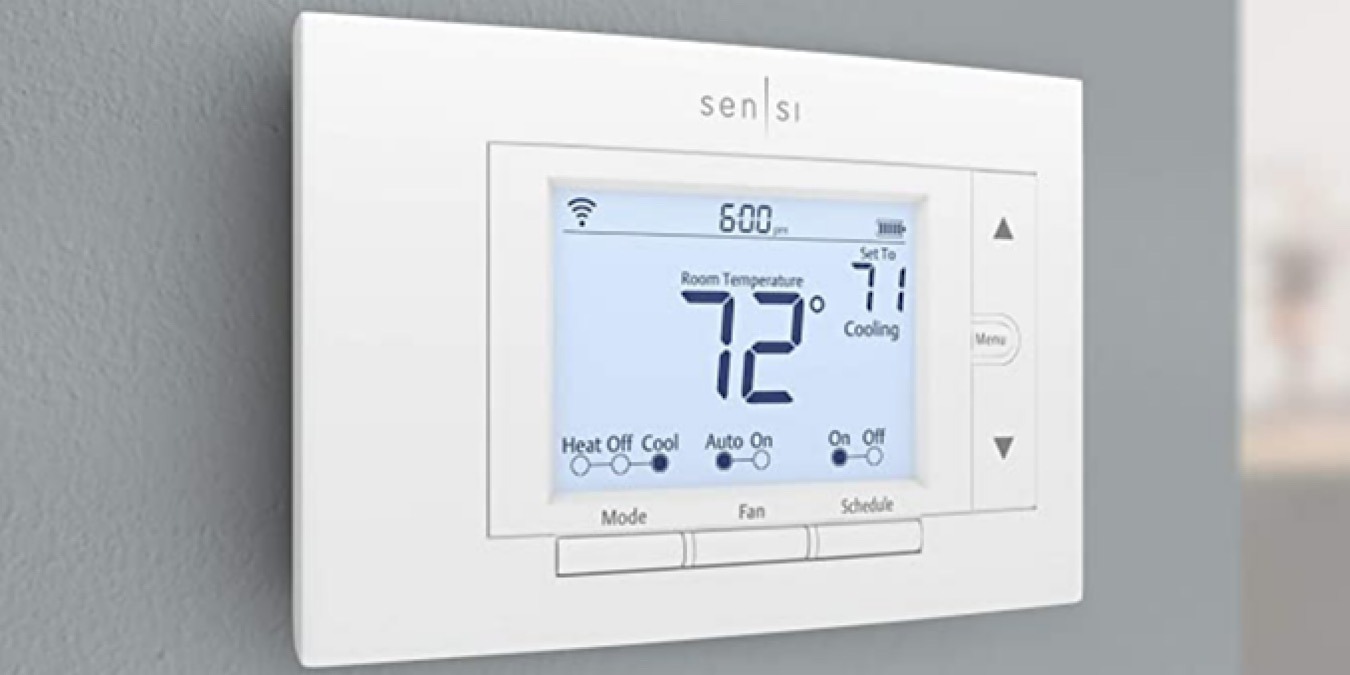
There isn’t much worse than getting all settled in, laying in bed, realizing it’s too warm in your bed, and having to get up and walk to the thermostat to turn the temperature down a little. With an Emerson Sensi Smart Thermostat, you never have to leave the comfort of your bed or favorite chair, as you can change the temperature on this smart home device with Alexa.

USA Today reviewed the Emerson Sensi and voted it Editor’s Choice as the best value. It typically installs in 30 minutes or less. You’ll be able to install it quickly with its own built-in level and step-by-step instructions. Because it’s a standard thermostat size, you won’t need to patch the wall or paint behind it when you install it.

Deal Emerson Sensi Thermostat Hvac

The Emerson Sensi Smart Thermostat has extensive compatibility and works with the HVAC equipment found in most homes. A C-wire is required for heat-only, cool-only, and heat pump systems. You can check the compatibility of your system as well as your router on the website. Along with Alexa, it also works with Google Assistant, Apple HomeKit (requiring a C-wire), and Samsung SmartThings.

You’ll save about 23% on HVAC ENERGY. The thermostat is ENERGY STAR-certified, saving you money. It features geofencing, seven-day flexible scheduling, remote access, and in-app system usage. From the app, you can monitor the current day usage and check out the historical stats of the heating, cooling, and fan runtimes.

Take 24% off this smart thermostat, and pay just $99.35.

Emerson Sensi Smart Thermostat

Make Tech Easier may earn commission on products purchased through our links, which supports the work we do for our readers.

Subscribe to our newsletter!

Our latest tutorials delivered straight to your inbox

Laura Tucker Avatar

Read next

Adults who find it physically painful to ask for help, even when they are completely overwhelmed, usually aren’t proud — they are people who realized at an early age that relying on others resulted in disappointment, so they built a hyper-independence to ensure they would never be at the mercy of someone else’s reliability again
Research says people who never post on social media aren’t antisocial, secretive, or behind the times — they have noticed that performing their life cost them the ability to live in it
Scott Kelly spent a year in orbit while his identical twin brother stayed on Earth, and when he came home NASA discovered his gene expression had changed in ways that didn’t fully reverse
The Voyager Golden Record has a small sample of uranium electroplated onto its cover, put there so that whoever finds it can measure how far the metal has decayed and work out how long the record has been drifting, a built-in clock for a message engineered to last around a billion years.
Cognitive scientists have a name for the moment you finish a page and realize you took in none of it, and a Harvard study that caught people’s thoughts at random found the mind wanders off from whatever the body is doing for almost half of waking life.
When headlines declared that an MIT study had proven ChatGPT “makes you stupid,” the researchers behind it posted a page asking journalists to stop using words like “dumb” and “brain rot,” because their paper, based on 54 students writing essays, never said anything of the kind.
In 1245, London engineers built a massive underground lead pipe to bring fresh water three miles into the heart of the city—but during royal weddings and coronations, the city authorities would secretly disconnect the water supply and hook the pipes up to massive vats of claret, turning the public fountains into a political bribe that ran with free wine for days
A famous African Grey parrot named Alex became the first and only animal to ever ask an existential question about itself—after learning over 100 English words, identifying shapes, and counting objects, Alex looked into a mirror and asked his handler, “What color?” to learn that he was grey