

Artificial intelligence just gets smarter and smarter. At a certain point it seems like there’s no limit to what it can do. It continues to be more and more useful while at the same time being more and more awe-inspiring.
The most recent advancement in artificial intelligence technology is that it can guess what you look like with accuracy. It’s not perfect, but the results are still stunning with the knowledge it is only based on your voice.
Also read: 15 Interesting AI Experiments You Can Try Online
Speech2Face AI Guesses What You Look Like Based on Your Voice
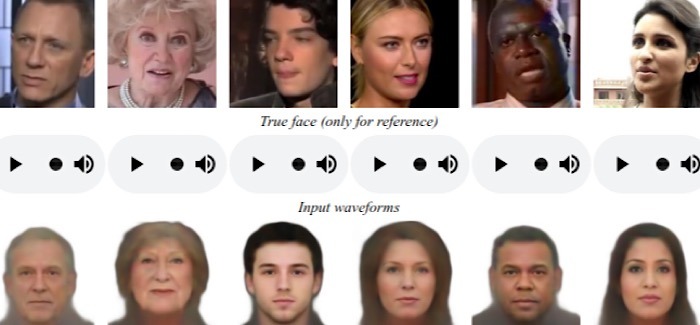
Researchers at the Massachusetts Institute of Technology created Speech2Face, artificial intelligence that analyzes a short sample of a person’s voice and uses that to reconstruct what the person may look like.
Again, it doesn’t produce a mirror image, but it’s still very close, making Speech2Face somewhat creepy while also being stunning, noting that it uses just a very small sample of a voice.
A paper was published this past week with the MIT team describing its work of training a generative adversarial network to analyze short clips of voices to “match several biometric characteristics of the speaker.” This results in “matching accuracies that are much better than chance,” according to the researchers.
A deep neural network was designed and trained to carry out this work using millions of videos of people speaking on YouTube or the Internet in general. It captured physical identifiers of people based on age, gender, and ethnicity.
On the Speech2Face GitHub page, researchers do raise caution as they acknowledge this technology does bring up questions of privacy and discrimination.
“Although this is a purely academic investigation, we feel that it is important to explicitly discuss in the paper a set of ethical considerations due to the potential sensitivity of facial information,” wrote the researchers.
They added that “any further investigation or practical use of this technology will be carefully tested to ensure that the training data is representative of the intended user population.”
The researchers also add the note that their goal isn’t to reconstruct an image of a person based on accuracy — their goal is to recover. identifiable physical features that correlate with the speech sample.
Where Is This Technology Headed?
As amazing as this technology is, it has to be questioned where it’s headed with this work. Like the warnings of the researchers, sensitivity needs to be used when using this technology, as it definitely seems like it can infringe on privacy.
When you speak and don’t visually appear in a recording, it’s with the knowledge that you won’t be seen. With the technology being developed, it brings up morality and legality. Many people would not be comfortable with this.
But technology such as Speech2Face can’t be stopped. Technology continues to develop, sometimes in uncomfortable ways. Does it make you uncomfortable that someone can figure out what you look like just based on your voice? Let us know what you think in the comments.
Image Credit: Speech2Face via Futurism and Public domain