This isn’t news that Apple needed. Just when they’re preparing to launch their feature that forces developers to divulge what customer data they’re tracking, a developer has discovered multiple scam apps on the App Store, with some raking in millions.
Discovery of Scam Apps
FlickType developer Kosta Elftheriou made the stunning discovery. His app is an Apple Watch keyboard that allows users to type with gestures on the watchface. He is the same developer behind the Flesky keyboard app that Pinterest acquired and Blind Type that was acquired by Google.
Elftheriou began highlighting apps that were similar to FlickType. But these apps are mostly non-functional, despite having ratings and bringing in revenue from subscriptions.
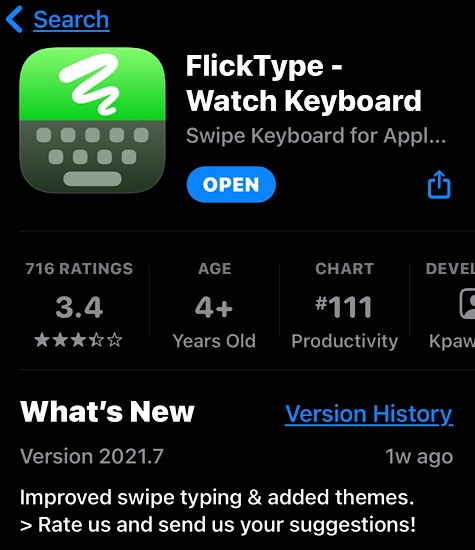
A few weeks ago he started detailing his findings on Twitter. He first started tweeting about the KeyWatch app: “Just a few months ago, I was way ahead of my competition. By the time they figured out just how hard autocorrect algorithms were, I was already rolling out the swipe version of my keyboard, quickly approaching iPhone typing speeds. So how did they beat me?
“First, they made an app that appeared to fulfill the promise of a watch keyboard – but was practically unusable. Then they started heavily advertising on FB & Instagram, using my own promo video, of my own app, with my actual name on it.”
It’s definitely an allegation that’s eye-popping, and it only gets worse.
When the app was downloaded, it would show a blank interface with an “Unlock now” button. Once the user tapped that, they would be prompted to buy an $8/weekly subscription. That’s pricey for a watch keyboard app, especially one that’s deceiving users, doesn’t work, and is really a scam app.
On top of that, the ratings and reviews for KeyWatch were fake. They were bought and paid for by the app’s developers. The KeyWatch team was making $2 million/yearly, according to data from Appfigures.
Apple’s Reaction
After Eleftheriou outed the app on Twitter, Apple removed it from the App Store, along with a few other scam apps that were also posing as Apple Watch keyboard apps.
However, as Eleftheriou tweeted in a followup, “While the ‘KeyWatch’ $300k/month scam was removed, Apple did ‘not’ take down their developer account.” He added, “Not only that, but their other scam, ‘GPS Speedometer,’ remains on the App Store stealing $200k/month from unsuspecting people with $416/year subscriptions.”
As he said, “Unreal.” By the way, a quick check shows the app still on the App Store.
Eleftheriou didn’t stop there. He’s still uncovering more scam apps on the App Store. He followed this by tweeting a quick tutorial: “Up to now, I’ve been in the ‘Apple wants to do the right thing’ camp. My viewpoint is starting to change.” He titled his tutorial: “How to Spot a $5M/Year Scam on the @AppStore in 5 Minutes Flat.”
Other honest developers are also chiming in on Twitter with possible solutions. One suggested Apple eliminate weekly subscriptions. Another suggested that the ‘Manage subscription” option should be there in the app instead of the Settings app.
I’m guessing Facebook is laughing heartily about this. Apple has had their “holier than thou” attitude with user data, demanding Facebook, Whatsapp, and others be honest about what they’re doing with user data. Meanwhile, Apple appears to be looking the other way as users are bilked out of money by scam apps.
If you believe you’ve been bilked by one of these scam apps, let us know in the comments below.